






All printing methods we offer use eco-certified materials (according to ISO 9001)
Not sure which textile printing technique is best for your textile, T-shirt, cap, shirt, sweater or workwear?
Simply send us your design, artwork or text by email and we will tell you which textile printing technique is best suited. We choose the right printing technique depending on the size of the run, the colour of the textile, its composition (cotton/polyester/blend/eco textile) and the design to be applied to the textile. The temperature at which the textile will be washed also plays an important role in choosing the right printing method. For private use of T-shirts or other textiles, 30–40°C is the normal washing temperature depending on the fabric. For hospitality clothing, however, both the print and the textile itself must withstand boil washing.
How are the textiles in the online shop printed? Which printing method is used?
The printing method depends on everything from the uploaded design to the selected textile. We try to choose the best printing method for you. The print may show slight colour deviations, which is “normal” with every printing method. Larger colour deviations due to technical feasibility, or to make the print look “nicer”, are usually discussed with the customer by our production team in advance.
Most people know flock printing from football jerseys, where names and numbers are applied with flock. This print is velvety soft, washable up to 90°C and very durable. We take your artwork and convert it into a vector graphic free of charge, turning it into curves. Your design is then cut out of the flock film with a plotter. After the excess film is weeded by hand, the design is transferred onto the textile/T-shirt at approx. 180°C.
Flex printing is basically the same as flock printing, just with a different surface – smooth and raised. Flex prints are washable up to 60°C because, unlike flock, the film is not double-coated. This print is very durable.
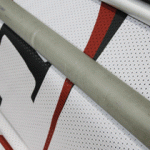
Sublimation printing is used for printing performance T-shirts, running shirts, light-coloured jerseys and textiles with a polyester content of at least 65%. In sublimation printing, the artwork is printed onto a carrier with a special printer, and this carrier is placed on the textile (performance shirt, sublimation shirt, blended T-shirt, running shirt). At approx. 200°C the printed ink turns into a gas and bonds with the polyester fibres of the textile. What makes this process special is that under normal circumstances it cannot be washed out, and there is no film or similar layer on the textile – it looks as if the T-shirt had been dyed in this colour during production.
Solvent printing is suitable for multi-coloured designs with sharp contours. The best example is the crests on football jerseys. A flex film is printed with eco-friendly solvent inks and cut precisely to the contour with a plotter. Solvent prints are washable up to 60°C and very durable.
Eco direct printing is like screen printing for single pieces. The design is printed directly onto the textile using the Brother GT3 X. On white shirts, the print is applied without a white underbase, so there is no tangible layer – only the colour is printed onto the textile. On coloured textiles, a white layer is printed underneath; it is very opaque and thick so that the colours remain visible on the textile. The print can be felt slightly afterwards (just as with screen printing on coloured textiles).
Screen printing is a popular method for larger textile runs. In screen printing, your artwork is separated into its colours (depending on how many colours your design has), and a separate screen is made for each colour. The ink is pressed through the screen with a squeegee. The T-shirt then goes through a drying tunnel so that the ink cures on the textile at a high temperature and becomes wash-resistant. Screen printing pays off from a run of approx. 100 identical shirts. It has high set-up costs (compared to other methods) but is the most affordable option for series production.
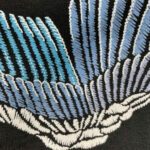
Our embroidery department offers embroidery as the classic method for applications where the decoration must withstand boil washing. In embroidery, your design is translated into stitches and your T-shirt is embroidered with the embroidery machine. The price depends on the size and the number of stitches. The cost of creating the embroidery file depends on the effort involved. Embroidery is very durable and recommended from 10 pieces.
Of course, our embroidery service is also available for single pieces.
We adapt our textile printing techniques to every need and every industry.

