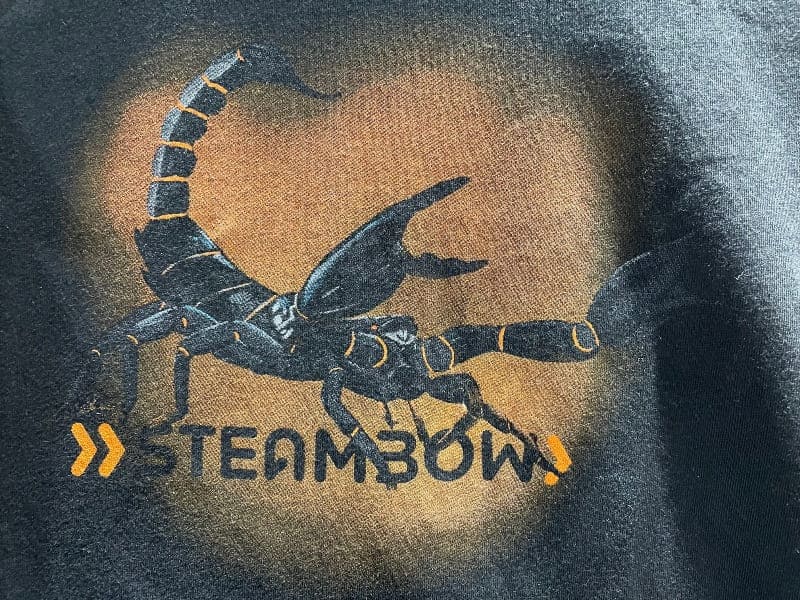
What is screen printing?

In screen printing, the design is transferred to the textile using a stencil (screen). A separate screen is made for each colour in the design.

How is screen printing done?

  1. First, the design is printed entirely in black on a film
  2. The screen is coated with an emulsion that only hardens when it comes into contact with UV light
  3. The printed film is placed on the screen frame. The screen mesh can be made of different materials (polyester, nylon or steel mesh)
  4. The UV lamp is held over the screen. During exposure, the emulsion hardens wherever the printed film (design printed in black – black so that it blocks the light) does not cover the screen. So the emulsion hardens wherever the UV light hits it – everywhere except under the black design
  5. The screen frame is then rinsed with water so that the unhardened emulsion washes out.
  6. Now the screen frame can be fixed above the textile.
  7. A squeegee is drawn across the screen so that the ink seeps through the unexposed areas and onto the textile. If the design has several colours, flash dryers are used for quick intermediate drying so that the other colours/screens can be applied on top without the colours running.
  8. Finally, the textile goes into an oven (drying tunnel), where it is dried thoroughly so that the ink cures and becomes wash-resistant.

We all know screen printing from the clothes we buy at fashion chains, as almost all large orders are produced with screen printing.

What makes screen printing special?

  1. Cost-effective for large runs: screen printing is ideal for runs from 50 pieces
  2. Very high durability: drying in the drying tunnel (oven) cures the ink, making the print long-lasting
  3. No single pieces possible: because of the individual steps needed to make the screen, it is not worthwhile for single textiles
  4. The textile is printed directly without any carrier material

What should you keep in mind with screen printing?

  1. Ideally, the design should have no more than 8 colours – the fewer colours, the more affordable
  2. Vector graphics are an advantage (if you don’t have a vector graphic, no problem – we vectorise your file free of charge, as long as you have a high-resolution image file, e.g. .jpg, .png, etc.)

How do I wash textiles printed with screen printing?

  1. Washable at 60°
  2. Wash inside out
  3. Do not tumble dry
  4. No delicate detergents, more info here

How should my print file be prepared?

Vector graphics (.eps, .ai, .svg, .pdf) are ideal. The print size in cm can always be adjusted. If you are not sure whether your artwork is suitable for screen printing, feel free to write to us at office@hollyshirt.at.

Drying tunnel
Screen frame
Screen printing machine
UV lamp